
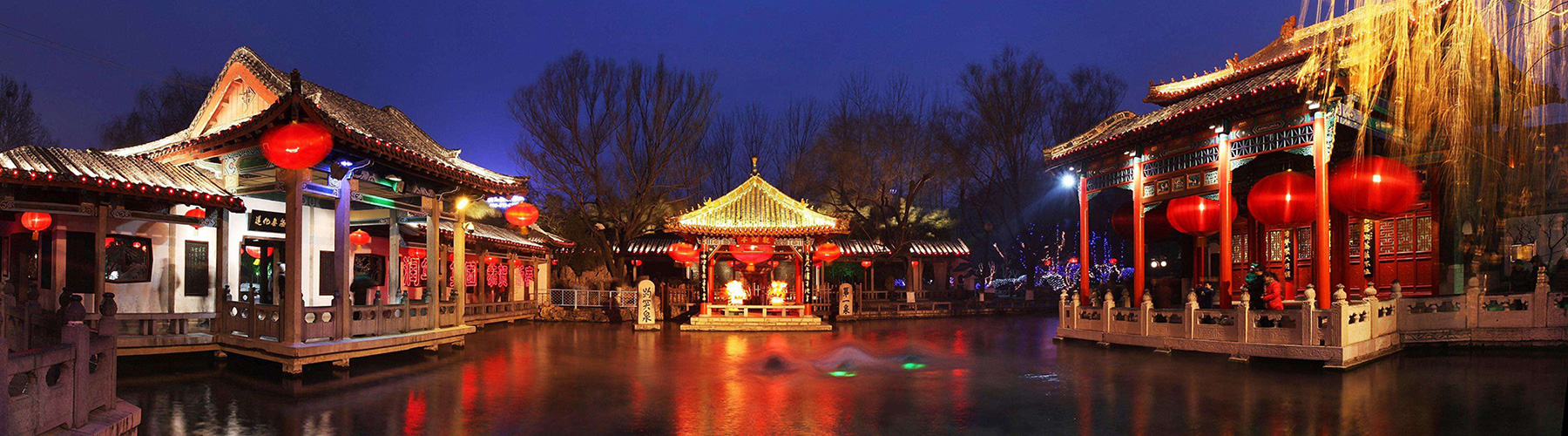

Setting Sun over the Waves, the North Water Gate and Huibo Tower
Setting Sun over the Waves is one of the Eight Old Scenes and one of today’s Sixteen New Scenes of Daming Lake. On the top of Huibo Tower, people can see the Thousand Buddha Hill on the south, while Que Hill and Hua Hill on the north. Under the tower, the water of the lake is shining below the sunset. In the past, the fishermen were singing merrily to go home for dinner after a day’s work. The harmonious and tranquil scene made visitors reluctant to leave. Hence people in the old time named this scene as “Setting Sun over the Waves”. The Chinese words were written by Liu Haisu, a great painter in China.The North Water Gate under Huibo Bridge is also called Huibo Gate. It was built by Zeng Gong when he was the governor of Jinan. In 1072, in order to manage the floods in the north area of Jinan, Zeng Gong took his men to build the North Water Gate. He composed an article named The Record of Constructing the North Water Gate. The article was written by a calligrapher named Chen Gengqiao and carved on the stele by the North Water Gate.Besides working as the water gate to control the water level of Daming Lake, the North Water Gate is also the north gate of the city of Jinan. With a history of one thousand years, it is well-preserved and still protects the old town from floods. It can be listed into the masterpieces of the ancient drainage works. Because of its sufficient water source from the springs nearby and convenient drainage, Daming Lake keeps its constant water level, unaffected by heavy rains or severe drought.Huibo Tower is located above the North Water Gate. It was first built at the beginning of the Yuan Dynasty and was rebuilt in the Yuan and Ming Dynasties. Today’s Huibo Tower was built in 1982. It is a two-storied traditional Chinese gate-tower. It is not only a good place to watch the views of the lake but also the location of Huibo Chess Club. The three Chinese words were written by Li Xiongcai, a modern calligrapher and painter.Located on the northeast bank of Daming Lake, Nanfeng Shrine (Zeng Gong Memorial) also named Zeng Gong Shrine, was built in memory of Zeng Gong, one of the Eight Great Masters of Tang and Song Dynasties. Zeng Gong was born in Nanfeng County of Jiangxi Province, so he was called “Sir Nanfeng” by scholars at that time. He was appointed as Chief Magistrate in Qizhou (today’s Jinan). He advocated innovations on the town’s laws and the local education, reduced the taxes, built north water gate, improved the drainage system and built pavilions and bridges on Daming Lake. Floods were effectively controlled and Daming Lake came into being from then on. He was so successful as a magistrate in Jinan that “local people blocked bridges, roads and gates to prevent Zeng Gong from leaving for next official position, and he had to leave late at night”. Therefore, the Memorial was built to commemorate him. It is not clear when Nanfeng Shrine was first built. It was rebuilt in 1829 in the reign of Emperor Daoguang of the Qing Dynasty. In 1994, it was rebuilt. There are three rooms in the Hall with Zeng Gong’s statue in the middle. Made of camphorwood from Zeng Gong’s hometown, the statue is two meters tall. With a book in the hand, the statue presents a learned and refined gentleman to the visitors. The couplets on the pillars are “As a great poet in the Northern Song Dynasty; Zeng Gong was honorably called Sir Nanfeng”. Across the Shrine is the old Opera House of Jinan, Nanfeng Stage. Jinan Folk Arts Troupe performs here everyday. Visitors from all over the world can enjoy the traditional and authentic folk arts of Jinan. There are five rooms on the east part of the Hall. Mr. Sun Mofo and his son’s calligraphies and paintings are on exhibition there. Yangong Terrace is in the east of the yard. Mingchang Bell Pavilion is on the terrace. Cast in the Jin Dynasty, Mingchang Bell is hanging inside the pavilion. Mingchang literally means Daming Lake will prosper for ever. The bell weighs eight tons with the Eight Diagrams on the surface and a dragon-shaped handle on the top. The couplets were written by Mr. XuBeiwen. The lines read “When the bell rings, the frogs are quiet; while the moon rises, the visitors’ dreams are awoken.” There is a waterside pavilion named “Rain & Lotus Hall” by the lake in the yard. With red pillars, green tiles, upturned eaves, tracery windows and gates and corridors around it, the pavilion faces the lake and is a good place to listen to falling rain and watch the lotuses. The Temple of Goddess of Lotus Root is also called “The Temple of the Goddess of Water”. There has been a custom to offer sacrifices to the Goddess of Lotus Root in Daming Lake. The original place is near Tie Xuan Memorial. It was recorded in The Travels of Laocan written by Liu E in the Qing Dynasty. The temple was rebuilt here in 1998. Based on the historical record from the Qing Dynasty, Li Qingzhao was regarded as the Goddess of Lotus Root. Her statue was worshipped inside it. The murals on the wall are the legends and pictures of Daming Lake. Beiji Palace is also called Beiji Temple and is one of the relics in Daming Lake. It is located on the north bank of Daming Lake. Originally built in 1280, it is the biggest Taoist Temple existing in Jinan. The whole temple consists of a bell tower, a drum tower, front and rear palaces, and wing rooms. In the front hall, the golden statue of Zhenwu God is in the middle of the niche, with Golden Boy and Jade Girl standing on both sides. Under the niche are Fire General, Water General, Turtle General and Snake General. On the two sides of the niche are six Gods in charge of different missions. On the east and west walls are the murals depicting the legends of Zhenwu God. Zhenwu was originally the prince of Jingle Kingdom in the west. Unlike other men, he was born with tremendous bravery and uninterested in the throne. He was fascinated by Taoism and gave up his throne to continue his religious training in Wudang Mountain in China. After 42 years’ hardship and training, he finally became Zhenwu God. The rear hall is Qisheng Palace which was built in 1465. Zhenwu God’s parents’ statues are enshrined in it. Beiji Temple is a high place on the north bank of Daming Lake. Standing on Beiji Temple, one can have a wide view of Daming Lake. The Spring of Response Well is located to the east of Beiji Temple. The spring was found out when Beiji Temple renovated in the Ming Dynasty. In 1514, a stele named The Record of the Spring of Response Well was erected by the spring. The article was written by Bian Gong, a well-known scholar at that time
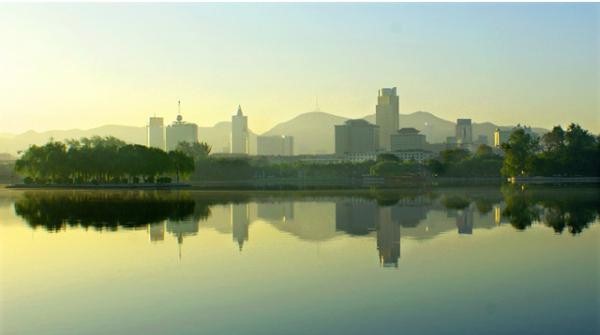
The Inverted Reflection of the Thousand Buddha Hill in Daming Lake and Tie Gong Memorial
In spring or autumn, visitors can enjoy the nice view of the inverted reflection of the Thousand Buddha Hill in Daming Lake at sunrise or sunset time. The best position to watch the view is around Xiaocanglang Pavilion in Tie Gong Memorial. In the book of The Travels of Laocan, the author Liu E vividly described this amazing scene which became popular all over China. This chapter of his book has been collected into the textbooks in China since Minguo Period. Tie Gong Memorial is located on the north bank of Daming Lake. It was built to memorize Tie Gong, the Minister of Defense in the Ming Dynasty. Tie Gong, also named Ding Shi, was born in Dengzhou in Henan Province. He was the provincial assistant administrator of Shandong in Emperor Jianwen’s reign of the Ming Dynasty. In 1400, Zhu Di, one of the emperor’s uncles marched from Beijing to scramble for the throne. At Jinan, Zhu Di was fought against fiercely by Tie Gong. Later, Zhu Di had to leave Jinan unconquered and finally broke through the defense of the capital Nanjing and became the new emperor. In the reign of Zhu Di, Tie Gong was defeated and refused to surrender. At last he was captured and tortured to death in Nanjing. It is not clear when Tie Gong Memorial was first built. In 1792, in the reign of Emperor Qianlong of the Qing Dynasty, Tie Gong Memorial was rebuilt by A Linbao, the official in charge of salt affairs in Shandong. It consists of the Shrine of Tie Gong, Xiaocanglang Pavilion, the Moon Pavilion, the Lakeside Corridor, the Lotus Pond and so on. It is a compound of garden. Inside the shrine, there is Tie Gong’s bronze statue which is 2.3 meters tall and weighs 1.8 tons. The statue is vividly modeled by traditional and modern artistic skills. On the walls of the shrine, there are eight calligraphies written in various styles of Chinese calligraphy among which are cursive hand, running hand, seal script, and regular script. There are also a lot of inscriptions including travel notes, poems, rebuilding record, commemorative articles which were written by some well-known poets or writers.
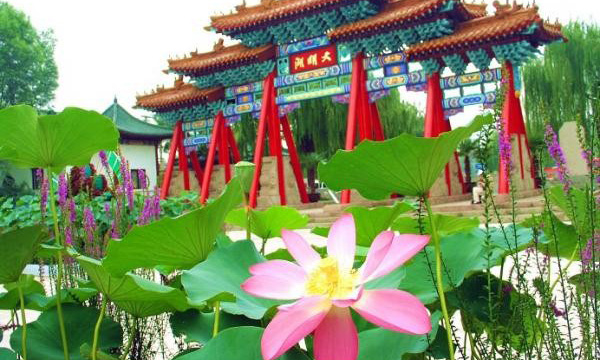
Dazzling Sun over Dan Archway& Daming Lake Archway
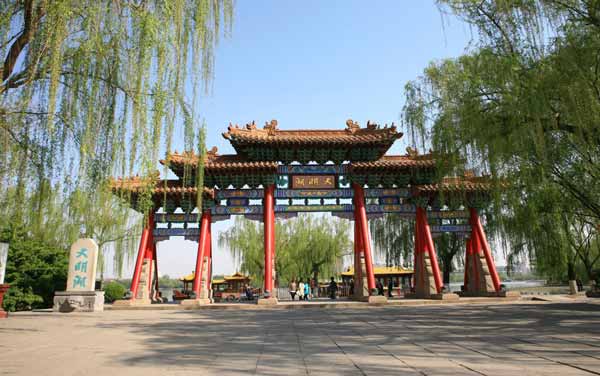
A traditional Chinese-styled archway stands at the south entrance of Daming Lake. It is regarded as the symbol of Daming Lake. Located on the stone stairs, the archway is 8.38 meters high and 14.7 meters wide. With single and upturned eaves, golden tiles and bright colors, the archway is well-proportioned and magnificent. The golden words of “Daming Lake” on the board were written by Yu Shudian in the Qing Dynasty. There are two streams along the two sides of the archway. The water of Pearl Spring and Zhuoying Spring gathers in Baihua Oasis and flows to Daming Lake from here. The archway is brilliant under the sunshine, hence the name “Dazzling Sun over Dan Archway”.
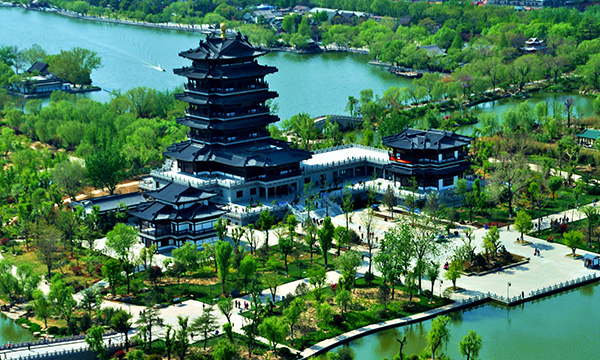
“Tranquility and Transcendence” and Chaoran Tower
If one is not after profit or fame, he will reach a high goal. Staying peaceful is a kind of attitude. Climbing up Chaoran Tower, one can stay away from the common customs and transcend borders to embrace the beyond. Chaoran Tower is the soul of the Scene of “Tranquility and Transcendence”. It was first built in the Yuan Dynasty. According to Licheng County Annals, Li Jiong, a well-known scholar in the Yuan Dynasty built it after he built a waterside pavilion by Daming Lake. Li Jiong (1274-1332), also named Gaizhi, was born in Tengzhou, Shandong. He was well-educated and talented. He was the official editor of the Imperial Academy and he took part in the editing of The Classics of the History. When the books were completed, he retired and lived in the villa of Chaoran Tower by Daming Lake. PuSongling, a well-known novelist of the Qing Dynasty once lived here. The building fell down many years later. Daming Lake was enlarged in 2009. Chaoran Tower was also rebuilt according to its old style. The rebuilt tower is a steel reinforced concrete old-styled building. It is based on a grand granite platform and the tiles, attachments, gates and rails are all made of copper. The boards and pillars are made in the skills of cloisonné enamel. The seven-storied building is 51.7 meters high and with a building area of 5673 square meters. The elevator can take visitors to the top floor to have a bird’s view of Daming Lake and Jinan. It is reputed as “Number One Tower in North China”. On the other floors, there are wood carvings, murals, pictures and descriptions to show the visitors the cultures of springs, gardening and customs of Jinan. On the first floor,the exhibition hall of “The Capital of Springs” shows the visitors the springs and culture of Jinan in three-dimensional animation. There are a lot of activities of “The Autumn of Que Hill and Hua Hill”, “Setting Lotus Lanterns in Daming Lake”, “The Painting Wall of the Views in Jinan”, “Taking Photos”, “Fictitious Turning Pages” and “Spring Flows over the Rocks”. Visitors can get involved and experience the magic of modern technology. On the second floor, there is a splendid wood carving facing the gate. The wood carving shows all the well-known scenic spots of Jinan, the City of Springs. The whole wood carving is made of nanmu wood and 8 meters high and 4.9 meters wide. Based on the real layout of Jinan, the carving shows the visitors the nice places and history and culture of Jinan On the walls of the hall, are the wood carvings of “The Eight Sights in Jinan” which are Baotu Spring Gushing to the Sky, The Spring of Jinping Hill, Viewing fish in Five Dragon Pool, The Black Tiger Spring under the Moon, Chrysanthemum of Thousand Buddha Hill, Misty Rain Over Quehua Bridge, The Clouds after Snowing and The Grand View of Lingyan Mountain. In the hall, visitors also can see the precious one thousand-year-old camphorwood carving of “Ten Thousand Horses Galloping ahead”, annatto wood carving of “Fortune and Happiness”, Long Yanmu wood carving of “The Nine Carps from the Dragon Mouth” and “A Roc Taking off with Tremendous Power and Momentum”. On the walls there are also the grand bronze carving of “Lotus festival on Daming Lake”, “The Autumn of Que Hill and Hua Hill” and the works of some local artists. In the north hall, there is a pottery show of “Lao Can and Old Jinan.” On the two sides of the elevator from the third floor to the sixth floor, there are painting shows of “The Eight Sights of Daming Lake” painted by some contemporary painters. On the third floor, there is a teahouse with a grand mural of “Ever-shining Sun and the Moon”. On the fourth floor, is a jade carving show of Mount Tai. On the fifth floor, is a show of precious and rare fossils. The sixth floor is a sightseeing terrace with a teahouse. Visitors can enjoy the nice view while drinking tea. Chaoran Tower is the highest point of Daming Lake Scenic Area. It is splendid and grand. It is like a roc taking off with tremendous power and momentum. Ascending the tower, visitors will enjoy the amazing and picturesque view of Daming Lake and have a bird’s view of Jinan. Linked with Chaoran Tower, is Boyi Hall. It was originally the antiques show room in Xia Garden and was destroyed in the war. It was rebuilt recently with an area of 1250 square meters. It is the exhibition room of works of some well-known painters and calligraphers. To the south of Chaoran Tower, is Hesheng Studio which got the name from the former Hesheng Theatre Street.
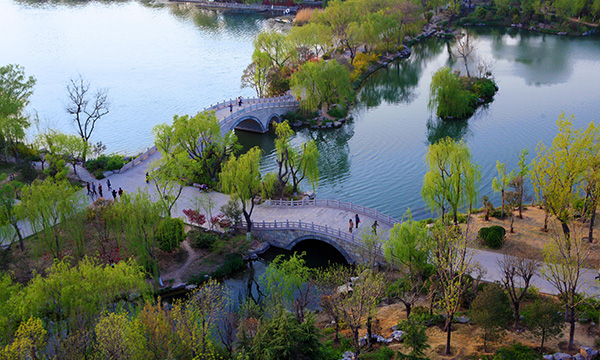
Ripples around Zeng Causeway
Zeng Causeway was built on the southeast bank of Daming Lake for sightseeing by Zeng Gong, the former governor of Qizhou in the Song Dynasty. Zeng Gong was one of the Eight Masters of ancient prose in Tang and Song Dynasties. Zeng Causeway is also called Baihua Causeway (Causeway of Flowers). Located to the south of Daming Lake, the scenic spot covers an area of 19,959 square meters. With the drooping willows, colorful flowers and ripples patting against the causeway, it is now one of the sixteen spots in the Park.
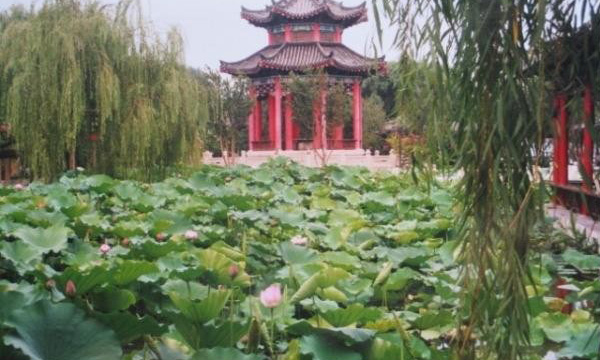
Lotus Charm of Canglang&Xiaocanglang Pavilion
In midsummer, the lotuses in the pond of Xiaocanglang are in full blossom and present a marvelous view to the visitors. The Chinese characters of “Lotus Charm of Canglang” on the horizontal inscribed board were written by Dong Qichang. The couplets of “The moon over the lake around the town; the willows above the city walls” were from the poem of Yuan Yishan in the Jin Dynasty and were written by a local calligrapher named RenXiaolu Xiaocanglang Pavilion is located in the yard of Tie Xuan Memorial. It was built in the 57th year of the reign of Emperor Qianlong in the Qing Dynasty in the same style of Canglang Pavilion in Suzhou. The two words“Canglang” were from the article Fisherman in The Songs of Chu. The lyrics are “Canglang Water is so clear that it can wash the ribbons of my hat; the Canglang Water is so muddy that it can wash my feet.” Hence Canglang Pavilion got its name. Canglang Pavilion here is smaller than that one in Suzhou so it is named “Xiaocanglang Pavilion” (Xiao means little). Xiaocanglang Pavilion was built near the lake. The name of it on the horizontal inscribed board was written by JueLuoChongen, the governor of Shandong at that time. Xiaocanglang Pavilion faces the lake in one direction and is surrounded by the lotus pond in other directions. Around it was built a winding corridor, which is the best position to watch the lotuses in summer and enjoy the inverted reflection of the Thousand Buddha Hill in the lake. In the past time, Xiaocanglang Pavilion was once the place for people to drink tea and write poems. The unique views attracted a lot of poets and calligraphers to have parties here. They drank and wrote poems here and left many popular lines among which “With lotus flowers on four sides and weeping willows on three sides; half of the hilly city is reflected in the lake” are the best-known. The lyrics were composed by Liu Fenggao and written by a great calligrapher Tie Bao. Liu Fenggao was a historian and an official in charge of education in Shandong in the Qing Dynasty.
A Brief Introduction to Daming lake
Daming Lake has has beautiful scenery and a long history of 1500 years. Daming Lake has been repaired after several changes. Zeng Gong, one of the Eight Great Men of the Tang and Song Dynasties, who built bridges and pavilions in DamingLake laid the foundation for today\'s sightseeing. In 2007, Daming Lake carried out the largest renovation and expansion project in history.Afterthat ,theDaming Lake expanded from "Garden Lake" to "City Lake",realizing the linking with small East Lake and the navigation with moat. There are famousSixteen Scenes in The Daming Lake.