
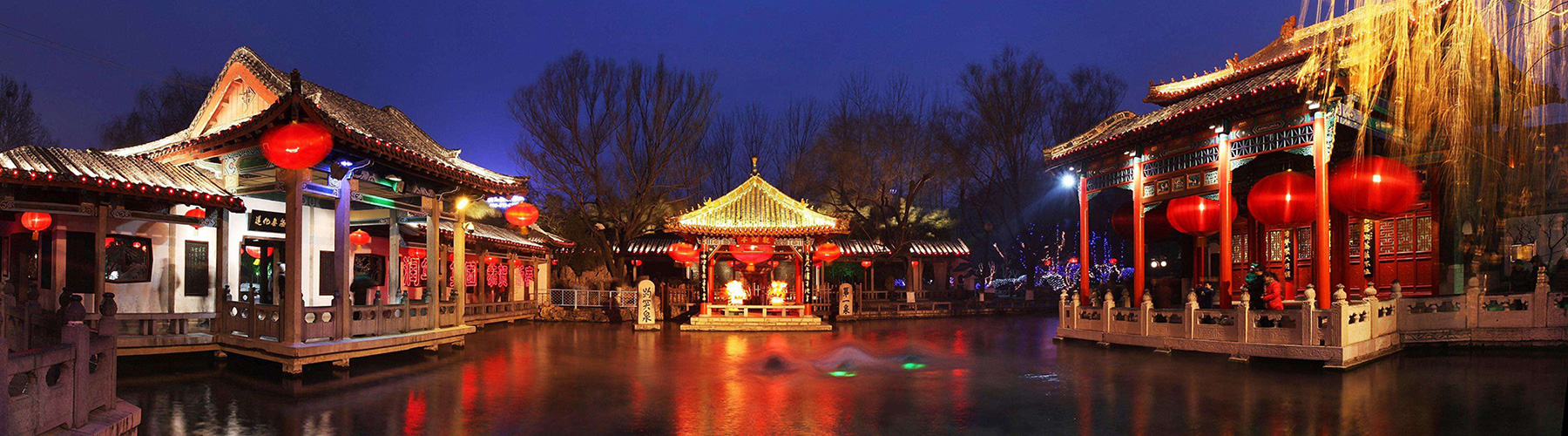
Baotu Spring
Baotu Spring Park covers an area of 10.5 hectares of central Jinan. It is a cultural park famous for its springs. Baotu Spring ranks the first of the 72 famous local springs, thus the symbol of Jinan, the city of springs. As the old saying goes “Your visit to Jinan cannot make a visit without visiting Baotu Spring”. The Park boasts many famous springs. Baotu Spring and 20 other neighbouring springs, including Jixian Spring, Shuyu Spring, Liuxu Spring, Mapao Spring and Wuyou Spring, form the Baotu Spring Group, the best among the 4 spring groups in Jinan. Emperor Qianlong of the Qing Dynasty granted the great title of “The First Spring under Heaven” to Baotu Spring after he tasted the delicate fragrance of the tea infused by it on his south tour. With a rich cultural heritage, Baotu Spring Park is abundant in historic interest and scenic beauty, including Luoyuan Hall, E & Ying Shrine, Guanlan Pavilion, Laihe Bridge, Pengshan Arch, Shangzhi Hall, Li Qingzhao Memorial, Former Residence of Yi’an, Baixue Tower, Wanzhu Garden, Cang Garden as well as many famous springs and stone tablets. They combine to make Baotu Spring Park the cradle of the unique spring culture in Jinan. The newly built attractions, including Luoyuan Garden, Baihua Garden, the May 3rd Memorial Garden and the boat stop, integrate harmoniously with the existing scenic spots. The graceful and classic park features springs, tea, opera, specialty and souvenir shopping. It also offers a huge variety of cultural activities and events, such as shows of Chinese painting and calligraphy, miniature landscape, autumn chrysanthemum and Spring Festival lanterns and opera performance, which have enriched the traditional culture of the park.
Best SpringBest Spring
The World's Best Spring Scenic Area, located in downtown Jinan, capital of Shandong Province, consists of one river ( the Moat), one lake (Daming Lake), three springs (Baotu, Black Tiger and Five-dragon Pond springs) and four parks (Baotu Park, Huancheng Park, Five-dragon Pond Park and Daming Lake) and. An embodiment of the unique landscape of natural water springs and a profound historical and cultural heritage, it forms an important part of the characteristics of Jinan, the City of Springs. The Scenic Area, built around the Baotu Spring, which is knows as the Best Spring in the World, is further divided into three major spring groups, Baotu, Black Tiger and Five-dragon Pond spring groups, which stand in harmony with the ancient walls and mansions from the Ming Dynasty, where springs, rivers, lakes and towns are seamlessly integrated and present a spectacular picture as described in a poem: Every household has springs and weeping willows in front of their homes with water running over stones. The spring water breaking out of the ground is a truly remarkable thing to see. Of these major springs, the Baotu Spring comes on the top, as it throws water several feet up in the air, roaring and churning, a scene that has been ranked the top of the eight must-sees in Jinan since the Ming and Qing Dynasties. The Black Tiger Spring, guarded by three formidable beasts carved out the stone, is forever gushing out a huge amount of water, while the Five-dragon Pond is overwhelmed by a sense of tranquility, with a pool of deep and limpid water hidden away in a mysterious shade of trees. These springs gurgling with water day in and day out form countless streams that rush into the moat and the Daming Lake, giving birth to a complete, unique landscape belt encompassing the old district of Jinan and which has come to known as the only one of it kind in China. You can take a cruise boat down on the moat while sipping tea and appreciating the bubbling water and the playful fish disappearing into the swaying aquatic plants now and then, until you suddenly find yourself in the Daming Lake. Along the route, you can see a number of places of interests and historic relics among the weeping willows, including the Luoyuan Temple, Lixia Pavilion, Nanfeng Temple, Jianxuan Temple, Li Qingzhao Memorial Hall, Chaoran Tower, Baixue Mansion, Teixuan Temple, Shangzhi Temple, Cang Garden, Ten-thousand Bamboo Garden, Autumn Willow Park, "Lao She and Jinan Gallery, and Liberation Pavilion. As scenery unfolds, it also shows the landscapes and the cultural and historical sites that are unique to Jinan, a city known for its springs.
Best Spring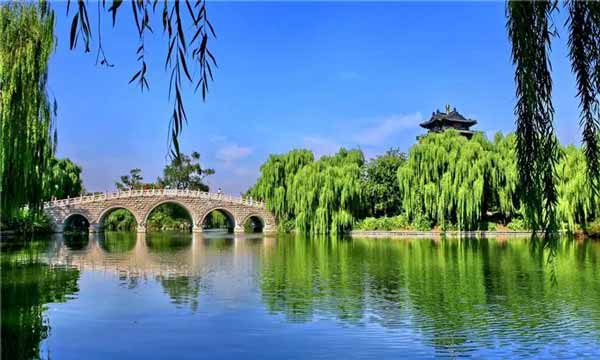
Misty Rain over Quehua Bridge
Misty Rain over Quehua Bridge is one of the eight old scenes of Jinan and one of today’s sixteen newly-built scenes. Quehua Bridge is an ancient single-hole stone bridge. Standing on the bridge, one can see Que Hill and Hua Hill are like two dancing fairies in green. The paths crisscross in the fields in the countryside. The cooking smoke rises from the houses of the villages. This peaceful scene is like a Chinese ink painting. The greatpainter Zhao Mengfu in the Yuan Dynasty once drew The Autumn Scene of Que Hill and Hua Hill which became a masterpiece. The painting is now kept in the Palace Museum in Taipei.
天下第一泉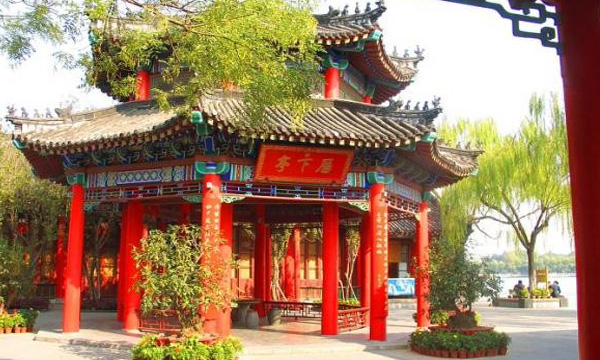
Lixia Autumn Wind and one thousand-year-old Lixia Pavilion
Lixia Autumn Wind was one of the eight old scenes of Jinan and is one of the sixteen scenes of today. In hot summer, when visitors come to Lixia Pavilion by boat, they will enjoy the cool from the breeze around the island and the fragrance of the lotuses. When autumn comes,the reeds sway gently in the autumn breeze. Visitors will feel refreshed and relaxed. People in the past time named this scene as “Lixia Autumn Wind.” Lixia Pavilion is a time-honored pavilion. It is located on the biggest island in Daming Lake and is also called Ancient Li Pavilion. It was first built as Guest Pavilion in the Northern Wei Dynasty and with a history of 1500 years. In 745, the well-known poet, Dufu came to Jinan during his trip to Shandong. His friend Li Yong who was the governor of Beihai State (today’s Yidu County) came to Jinan to entertain Dufu in the Pavilion. They were good friends despite the great difference in age. Upon the warm reception, Dufu wrote a poem named The Banquet with Li Beihai at Lixia Pavilion., in which “Lixia Pavilion is antique in Shandong; Jinan abounds in celebrities” has become the best-known lines through all ages; hence the great reputation of Lixia Pavilion. Today’s Lixia Pavilion was rebuilt in 1693, the 32nd year of the reign of Emperor Kangxi in the Qing Dynasty. With red pillars, green tiles and eight-edged multiple eaves, the reconstructed Lixia Pavilion is a typical timber structure in classic style. The three golden characters on the red horizontal inscribed board were written by Emperor Qianlong in the Qing Dynasty. The couplets of “Lixia Pavilion is antique in Shandong; Jinan abounds in celebrities” along the two sides of the gate were written by He Shaoji, a calligrapher in the Qing Dynasty. Inside the Imperial Stele Pavilion, there is a poem stele written by Emperor Qianlong in the Qing Dynasty when he visited Daming Lake. To the north of the Lixia Pavilion are a huge hall called “Celebrities Hall” and a hall of three sections named “Weilan Hall”. The name of “Celebrities Hall” was once the office’s name of Zeng Gong and was written by Zhu Qingyuan, a calligrapher in the late Qing Dynasty. The couplets on the two pillars were written by the great writer GuoMoruo in 1959, which are: “The whole world is peaceful among the weeping willows and spring wind; Daming Lake is as bright as a mirror with lotuses under the autumn moon.” On the walls inside the pavilion, there are the portraits of the celebrities of Jinan from the Qin Dynasty to the Qing Dynasty. With red pillars, green tiles and corridors on four sides, Weilan Hall got its name from the same blue color of the lake water and the sky.
天下第一泉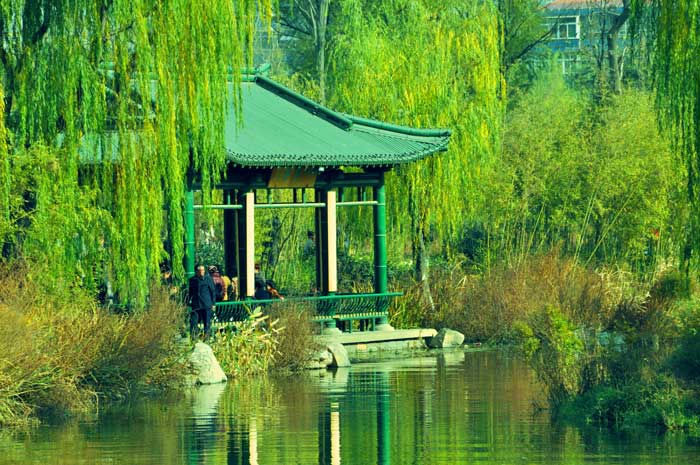
“Breeze at Bamboos”
In the past time, there was a huge bamboo wood on the southeast bank of Daming Lake. In the Ming Dynasty, a well-known official, Zhao Shiqing built Xiaoqi Garden which became a well-known garden and literary salon since the Ming Dynasty. It is one of the “Sixteen Spots in Licheng”. In order to develop the cultural connotation and inherit history, this historical spot will be rebuilt in the new area of Daming Lake Park.
天下第一泉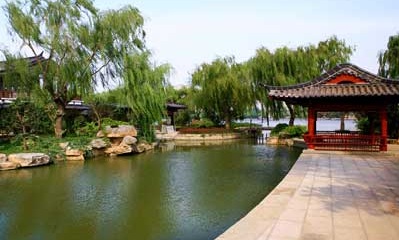
“Autumn Willows” and Qiuliu Garden
According to Licheng County Annals, in the Qing Dynasty, a well-known poet, Wang Yuyang once read books, wrote poems and met his friends in Qiuliu Garden by Daming Lake. He once wrote The Four Chapters of Qiuliu here. In the late autumn, visitors come to the garden to watch the yellow willows swaying over the water and experience the same feelings of the poet. It seems like a dream. This is the scene of “Autumn Willows”. Wang Yuyang (1634-1711) was also named Wang Shizhen, Zizhen, Yuanting and Hermit Yuyang. He was born into a family of scholars and officials. He started school at the age of six. He could write poems at the age of eight. His poems collection was published when he was fifteen. At the age of seventeen, he entered for the imperial examinations to admit scholars and ranked as number one for three tests. He was honored as a genius. He wrote four poems of Qiuliu by Daming Lake when he was twenty-four. He took the autumn willows as a metaphor to show his longing for his homeland. When the poem Qiuliu came out, it gained sympathy from a lot of people especially the intellectuals from the Ming Dynasty. These poems had set foundation for him to become the leading role of the poetry. Wang Yuyang also created the Theory of Romantic Charm, which set the style for poetry writing for half a century. He was a famous poet and scholar in Chinese literature. He became a Jinshi (a successful candidate in the highest imperial examinations) at the age of twenty-five. He started to be an official from the age of twenty-six and later became Minister of Justice. He was a well-known honest and upright official. Besides working as an official, he wrote over 560 volumes in 36 different styles. Qiuliu Garden is located on the south bank of Daming Lake. It faces Lixia Pavilion across the lake. The gate of the garden faces the south and on the top of the gate there are three words of “Quliu Garden” written by He Shaoji, a calligrapher in the Qing Dynasty. The couplet on the pillars were created by QianMingshi in the Qing Dynasty and written by Mr. JiXianlin, a master of Chinese culture. On the two sides of the gate,are the stele corridors on which inscribed the twelve poems of Wang Yuyang and The Record of Qiulin Garden written by Yuan Shishuo,a renowned professor of Shandong University. The main building in the garden is two-storied and in ancient style. On the first floor, there is a board inscribed with “Qingyuan Hall” on the top of the gate. The couplets, which were created by Wang Yuyang’s student, Yin Yanlai, were written by a well-known calligrapher, Wei Qihou. The main meaning of the couplets is: “Wang Yuyang’s articles are unrivalled, and all the men of virtues followed him.” The board of “Qiuliu Poetry Society” is above the gate of the second floor. The couplets were written by a famous modern calligrapher, Mr. OuyangZhongshi and the meaning of them is:“The poets exchanged views and communicated on writing poems at the foot of Li Mountain or in Qiuliu Garden”. The statue of Wang Yuyang stands in the hall downstairs. There is also an exhibition showcasing his life and literary achievements, ink slabs, seals, a folding fan from the emperor, antique furniture and blue-and-white porcelain. The second floor is home to Qiuliu Poetry Society, which is a meeting place for scholars. Wang Yuyang’s Rowing on Daming Lake hangs on its west wall, while the painting of “Wang Yuyang Meeting Friends” hangs on its east wall. There are two groups of buildings linked the Stele Corridor in the west of Qiuliu Garden. One is Lianzhi House and the other one is Tanyi House. In the east, is the Mirror Pavilion. On the back, is Tianxin Waterside Pavilion which got the name from Shao Yong’s poem “When the moon rises to the high sky, the wind blows over the water” of the Song Dynasty. This pavilion was built by Li Jiong, a great scholar in the Yuan Dynasty. Li Jiong, born in Tengzhou, once was a member of the Imperial Academy. He lived in Jinan after retirement. Qiuliu Household Qiuliu Household is located in “Wang Family Yard” on No.11 of the former Qiuliuyuan Street. It is an old yard preserved in the new area of Daming Lake. The people living here were once doctors for generations. The mansion has three compounds and is a typical northern courtyard. The layout of the house is in traditional Chinese Medicine Hospital style. The Prescriptions of traditional Chinese medicine hang in the central room. There are counters and doctor desks in the room. On the screen wall, is the stone carving of “Carps Jumping over the Dragon Gate” (succeed in the civil service examination in old times). In the second yard, the workshop of producing traditional Chinese medicine is on the east. On the west is the private school which is called “Shixi Studio” with Confucius’ portrait on the wall. The central room is also the sitting room. There are two pomegranate trees which are over one hundred years old in the yard. Walking through the sitting room, visitors can see the old trees and an old well. The main room is the parents’ bedroom. The east room is the son’s room and the east one is the daughter’s. The furniture is old. The decoration style shows the typical middle class’ life in the Minguo Period. Entering Qiuliu Household, both visitors and locals can experience the peace and sweetness of home in this miniature of traditional Chinese culture.
天下第一泉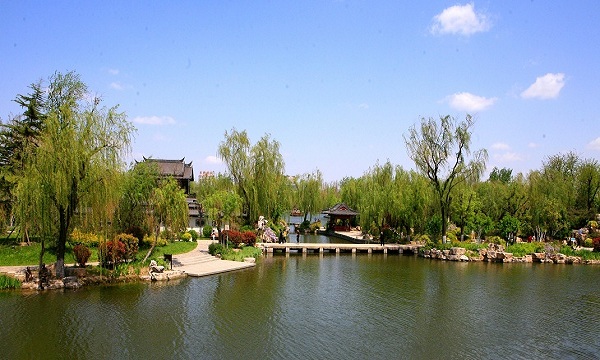
The Seven Bridges and Quehua Bridge
In the past time, there were seven bridges around Daming Lake, which were Quehua Bridge, Baihua Bridge,Furong Bridge,Shuixi Bridge,Huxi Bridge,Beichi Bridge and Luoyuan Bridge. They were different in style with wonderful scenery; hence the Seven Bridges became a great scene. From the Song Dynasty, a lot of poets composed poems based on the seven bridges such as “Since then the wind and moon over the seven bridges always come into my dream.” and “Green mountains outside the town while the lake inside the town, the wind and moon over the seven bridges and the pavilion.” After Daming Lake was enlarged,Luo Bridge was replaced by Qiuliu Bridge and other six bridges were rebuilt. The scene of “Seven Bridges” appears again. Besides the seven bridges mentioned above, there are twenty-eight sightseeing bridges in the new area, such as Meixi Bridge,Luhua Bridge,Ouhua Bridge,Ningxue Bridge,Nanfeng Bridge,Yuhan Bridge,Zhuyun Bridge and You’an Bridge. They vary in style and link the new area into a whole, with the traditional scene of small bridges and brooks everywhere. As the part of the scene of “The Seven Bridges”, Quehua Bridge, first built in the Northern Song Dynasty, is a well-known ancient bridge over Daming Lake. The original bridge was pulled down in 1948. Emperor Qianlong of the Qing Dynasty came up to the bridge twice and wrote poems on it. He also took the painting Quehua Bridge from the Forbidden City to compare the real view here and took notes on the painting. The rebuilt bridge is marvelous and magnificent with Yanyu Hall to the west and Quehua House to the east. Near Quehua Bridge, are Erlang Temple, “Yubin Mansion”, Shuixiang Pavilion, Yanyu Hall, Huishan Pavilion and Water Street. Erlang Temple is a group of historical buildings. According to the legends about God of Erlang controlling floods and catching monsters, there is always an Erlang Temple in the place of water so as to get good weather and harvest. In the ancient times, there was an Erlang Temple by Daming Lake. The road nearby was named after the temple. The folk rhyme of “East Gengdao, West Gendao, Wangfu Pond and Erlang Temple” was popular in the past time. In the rebuilt Erlang Temple, there are the statues of the God of Erlang, Xiaotian Dog and the “Six celebrities of Meishan” and murals of the stories of the God of Erlang. “Yubin Mansion” was renovated and rebuilt on the base of the original No. 6 of East Yubin Mansion. In the Ming Dynasty, the kings’ son-in-law was called Yibin. It was said that in the past time, a Yibin named Chen once lived here with his family. The street was named as Yubin which was homophonic as Yibin. In Revising Licheng County Annals, we can find the names of East Yubin Mansion Street and West Yubin Mansion Street. The renovated “Yubin Mansion” covers an area of 495 square meters, and it is the largest, the best-constructed and the most elegant courtyard among the courtyards in the old town of Jinan. Shuixiang Pavilion was first built in the Song Dynasty. Zeng Gong once wrote a poem Shuixiang Pavilion. The rebuilt pavilion is a place for sightseeing. Inside the pavilion, one couplet is “The sky shades in the pond, the bamboos bring autumn” and the other couplet is “The willows by the lake turn to green, the farmers start to work in the field.” The pavilion is surrounded by water. It is a quiet and nice place for visitors. Yanyu Hall covers an area of 1427 square meters. The first floor is the tourist center. The second floor is a shop of antiques. Together with Minghu House as theatres of folk arts, Quehua House facing Yanyu Hall was first built in 1890 (the sixteenth year in Emperor Guangxu’s reign). Covering an area of 2950 square meters, the rebuilt Quehua House is a high-class restaurant. Hui Hill is one of “The Three Invisible Hills” in the old town and very small. It hid in a courtyard in the old times. When it was enlarged, Hui Hill Pavilion was built near the hill with a stele about building the pavilion.
天下第一泉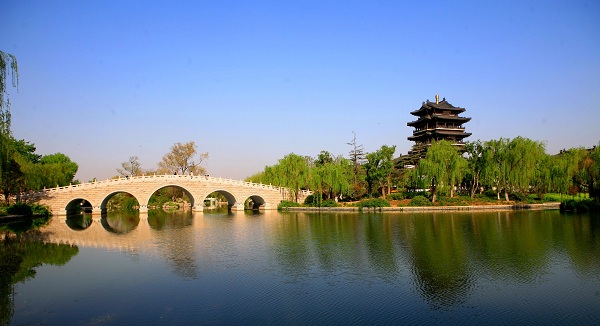
Bird Singing in the Woods and Beizhu Bridge
There is a long piece of land to the east of Quehua Road in the new area of Daming Lake Park. It is surrounded by weeping willows, luxuriant flowers, carpet-like grass and abundant trees. The luxuriant trees, carpet-like grass, flourishing lotus and reed in the water and various birds present a view of ecological habitat to the visitors. The lake water is as clean as a bright mirror with fish jumping out of ripples from time to time and birds flying over the water. Visitors walk in the woods and enjoy the amazing view and feel fresh. This scene is named as “Birds Singing in the Woods”. There are some historical sites such as Beizhu Bridge, Quehua House and Shuiyun House nearby.
天下第一泉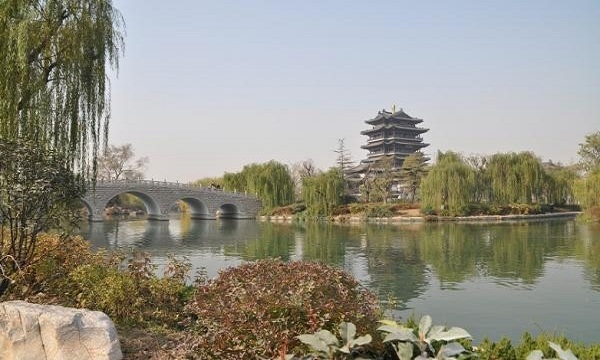
Autumn Moon over Daming Lake
On the autumn evenings, a lot of people come to Daming Lake to watch the moon. The lake is as bright as a mirror. The moon rises over the lake, the willows sway in the breeze and the air is overflowing with the fragrance of the lotuses. The night of the lake is also charming and comforting.
天下第一泉
Boating in the Lake & Huanbo Pavilion
Boating in the Lake is one of the eight old scenes of Jinan and one of today’s sixteen newly built scenes. Boats are the soul of Daming Lake. Whenever it is sunny or misty, rowing a boat or sitting on a decorated boat in the lake is a kind of enjoyment. Boating in the lake, we can see a square pavilion with green tiles and red pillars. It is Huanbo Pavilion which is also called Huxin Pavilion. It is located on an island in the center of Daming Lake. It was first built in the Song Dynasty and some poets once wrote poems about it. The pavilion we see today was rebuilt in 1990. With an area of 90 square meters, it is the biggest square pavilion in the city of Jinan. The poem on the stele in the pavilion was Huanbo Pavilion written by Su Zhe, one of the eight great scholars in the Tang and Song Dynasties.
天下第一泉