

Lixia Autumn Wind and one thousand-year-old Lixia Pavilion
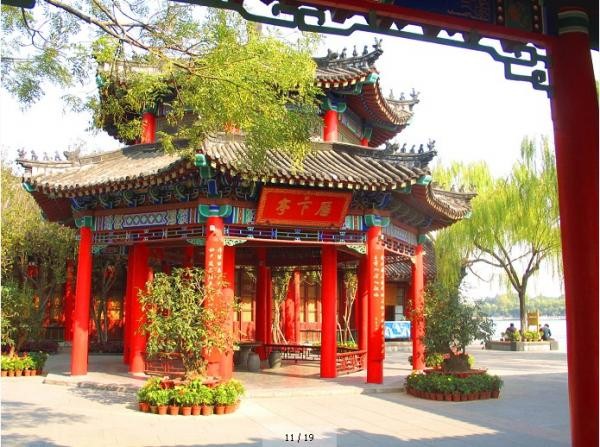
Lixia Autumn Wind was one of the eight old scenes of Jinan and is one of the sixteen scenes of today. In hot summer, when visitors come to Lixia Pavilion by boat, they will enjoy the cool from the breeze around the island and the fragrance of the lotuses. When autumn comes,the reeds sway gently in the autumn breeze. Visitors will feel refreshed and relaxed. People in the past time named this scene as “Lixia Autumn Wind.”
Today’s Lixia Pavilion was rebuilt in 1693, the 32nd year of the reign of Emperor Kangxi in the Qing Dynasty. With red pillars, green tiles and eight-edged multiple eaves, the reconstructed Lixia Pavilion is a typical timber structure in classic style. The three golden characters on the red horizontal inscribed board were written by Emperor Qianlong in the Qing Dynasty.
The couplets of “Lixia Pavilion is antique in Shandong; Jinan abounds in celebrities” along the two sides of the gate were written by He Shaoji, a calligrapher in the Qing Dynasty. Inside the Imperial Stele Pavilion, there is a poem stele written by Emperor Qianlong in the Qing Dynasty when he visited Daming Lake.
To the north of the Lixia Pavilion are a huge hall called “Celebrities Hall” and a hall of three sections named “Weilan Hall”.
The name of “Celebrities Hall” was once the office’s name of Zeng Gong and was written by Zhu Qingyuan, a calligrapher in the late Qing Dynasty. The couplets on the two pillars were written by the great writer GuoMoruo in 1959, which are: “The whole world is peaceful among the weeping willows and spring wind; Daming Lake is as bright as a mirror with lotuses under the autumn moon.” On the walls inside the pavilion, there are the portraits of the celebrities of Jinan from the Qin Dynasty to the Qing Dynasty.
With red pillars, green tiles and corridors on four sides, Weilan Hall got its name from the same blue color of the lake water and the sky.