
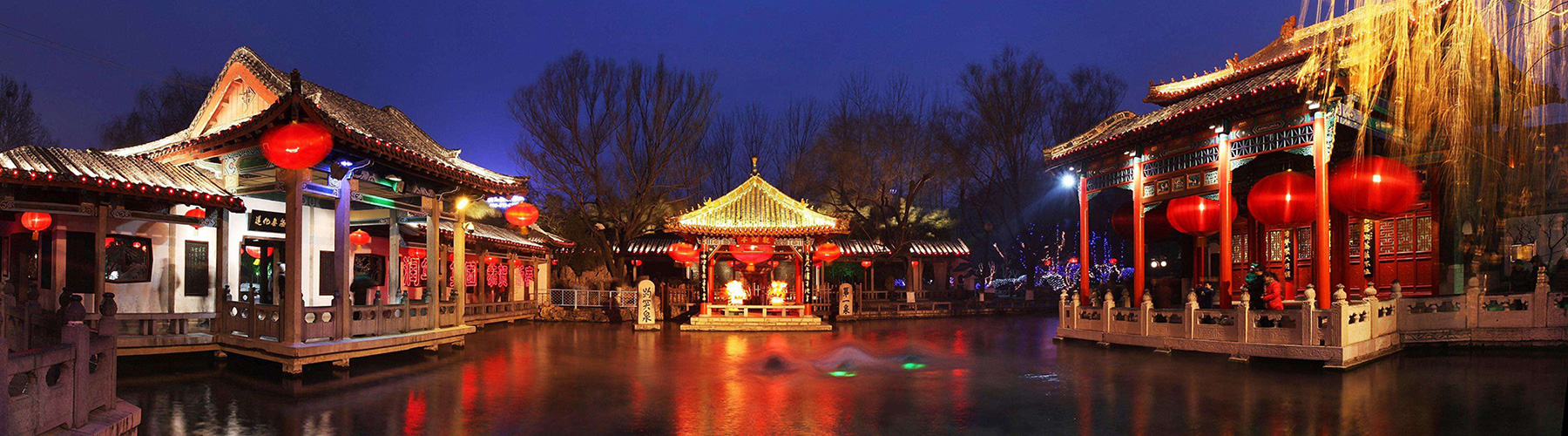
The Seven Bridges and Quehua Bridge
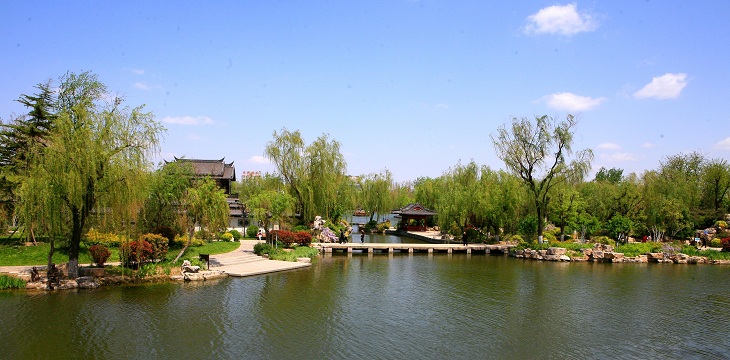
In the past time, there were seven bridges around Daming Lake, which were Quehua Bridge, Baihua Bridge,Furong Bridge,Shuixi Bridge,Huxi Bridge,Beichi Bridge and Luoyuan Bridge. They were different in style with wonderful scenery; hence the Seven Bridges became a great scene. From the Song Dynasty, a lot of poets composed poems based on the seven bridges such as “Since then the wind and moon over the seven bridges always come into my dream.” and “Green mountains outside the town while the lake inside the town, the wind and moon over the seven bridges and the pavilion.” After Daming Lake was enlarged,Luo Bridge was replaced by Qiuliu Bridge and other six bridges were rebuilt. The scene of “Seven Bridges” appears again. Besides the seven bridges mentioned above, there are twenty-eight sightseeing bridges in the new area, such as Meixi Bridge,Luhua Bridge,Ouhua Bridge,Ningxue Bridge,Nanfeng Bridge,Yuhan Bridge,Zhuyun Bridge and You’an Bridge. They vary in style and link the new area into a whole, with the traditional scene of small bridges and brooks everywhere.
Near Quehua Bridge, are Erlang Temple, “Yubin Mansion”, Shuixiang Pavilion, Yanyu Hall, Huishan Pavilion and Water Street.
Erlang Temple is a group of historical buildings. According to the legends about God of Erlang controlling floods and catching monsters, there is always an Erlang Temple in the place of water so as to get good weather and harvest. In the ancient times, there was an Erlang Temple by Daming Lake. The road nearby was named after the temple. The folk rhyme of “East Gengdao, West Gendao, Wangfu Pond and Erlang Temple” was popular in the past time. In the rebuilt Erlang Temple, there are the statues of the God of Erlang, Xiaotian Dog and the “Six celebrities of Meishan” and murals of the stories of the God of Erlang.
“Yubin Mansion” was renovated and rebuilt on the base of the original No. 6 of East Yubin Mansion. In the Ming Dynasty, the kings’ son-in-law was called Yibin. It was said that in the past time, a Yibin named Chen once lived here with his family. The street was named as Yubin which was homophonic as Yibin. In Revising Licheng County Annals, we can find the names of East Yubin Mansion Street and West Yubin Mansion Street. The renovated “Yubin Mansion” covers an area of 495 square meters, and it is the largest, the best-constructed and the most elegant courtyard among the courtyards in the old town of Jinan.
Shuixiang Pavilion was first built in the Song Dynasty. Zeng Gong once wrote a poem Shuixiang Pavilion. The rebuilt pavilion is a place for sightseeing. Inside the pavilion, one couplet is “The sky shades in the pond, the bamboos bring autumn” and the other couplet is “The willows by the lake turn to green, the farmers start to work in the field.” The pavilion is surrounded by water. It is a quiet and nice place for visitors.
Yanyu Hall covers an area of 1427 square meters. The first floor is the tourist center. The second floor is a shop of antiques. Together with Minghu House as theatres of folk arts, Quehua House facing Yanyu Hall was first built in 1890 (the sixteenth year in Emperor Guangxu’s reign). Covering an area of 2950 square meters, the rebuilt Quehua House is a high-class restaurant.
Hui Hill is one of “The Three Invisible Hills” in the old town and very small. It hid in a courtyard in the old times. When it was enlarged, Hui Hill Pavilion was built near the hill with a stele about building the pavilion.