
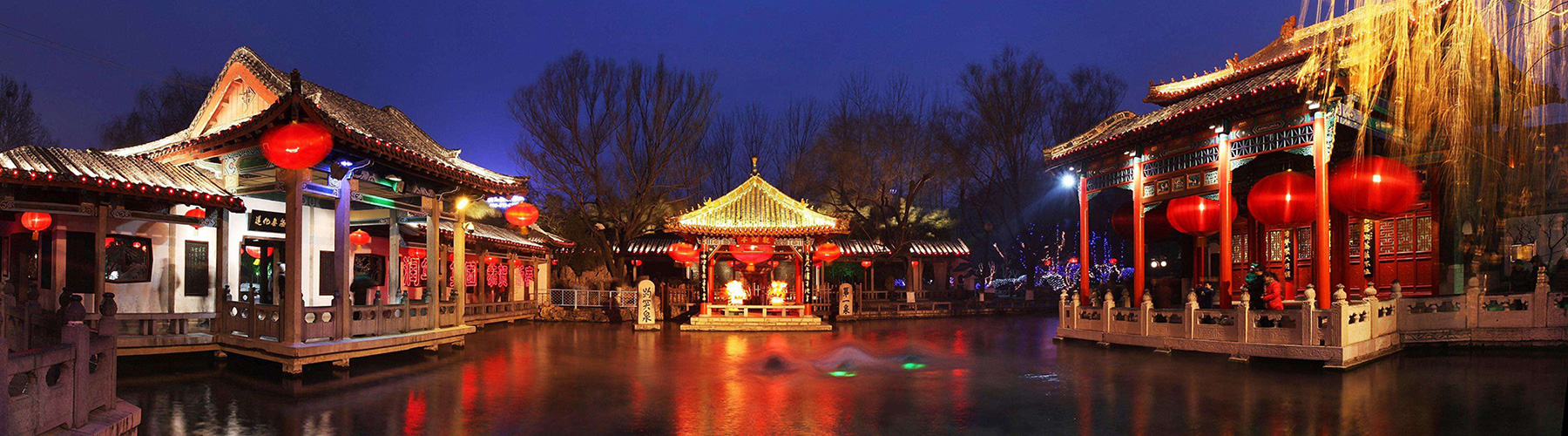
The Rhyme of Jiaxuan and Jiaxuan Garden
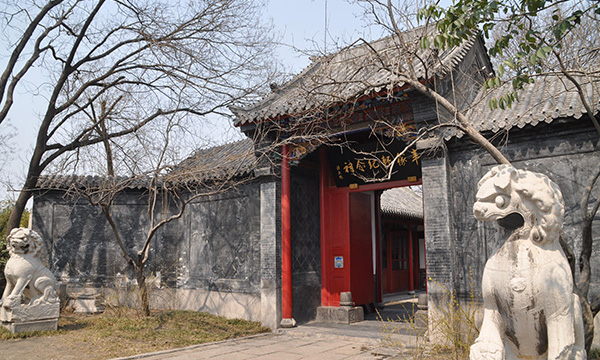
Walking into Jiaxuan Garden, visitors will know the life about the patriotic poet, XinQiji. He was a master of poems and his poems are unrivaled at his time. This is the Rhyme of Jiaxuan, one of the eight scenes in the newly built area of Daming Lake.
Jiaxuan Garden was originally called Jiaxuan Memorial. It was built to memorize XinQiji, a patriotic hero and one of the masters of Haofang (Bold and unconstrained) School in the Southern Song Dynasty. The garden was built in 1904 at the end of the Qing Dynasty. In 1964, our former foreign minister Chen Yi wrote XinJianxuan Memorial on the board. The memorial was named as the patriotic education base by the local government. Jiaxuan Memorial is a typical Chinese official building with three courtyards. Inside the yard, are the stele corridors, exhibition rooms,Jiaxuan Poetry Society and old trees. In the cabinets are displayed XinQiji’s representative works and big events in his life. XinQiji(1140-1207)was also named You’an and Jiaxuan. He was born in the eastern suburb of Jinan. He was a great hero of Anti-Jin Invasion in Chinese history and also a prestigious patriotic poet and essayist in the Southern Song Dynasty. XinQiji’s poems are magnificent in language and varied in style, either powerful and forceful or soft and graceful. In his lifetime, he wrote many poems, of which over 600 poems remained. The theme of his works is his faith to drive the invaders out of his motherland and his noble sentiment as an honest and upright man. His representative works are Ten Discussions on Meiqin and Nine Arguments. He enjoyed the same fame as Su Shi, another famous poet in the Song Dynasty. They were honored as “Su and Xin”.
Yangong Temple is a small stone courtyard which was built in the Qing Dynasty. It was preserved after Daming Lake had been enlarged. When it was renovated, a stelenamed “Yangong Temple” was discovered. According to historical research, it was built to memorize Master Yan. So it was renewed as Yangong Temple. The statue of Master Yan is in the niche and the murals on the wall are about the stories of him.
Yan Ying (578BC-500BC) was also named Yan Zhong. He was called Yan Ping after death. Chinese people used to call him Pingzhong. He was also honored as Master Yan. He was from Yiwei (today’s Gaomi in Shandong Province). He was a very important politician, thinker and diplomat in the Spring and Autumn Period. He was famed as a humble and thrifty man.
Yan Ying was very wise and loved his people. He helped the king of Qi State to rule the kingdom and gave him useful advices. He was a man of principle and flexibility. He once visited Chu State and argued heatedly with the king there to protect the fame of his motherland, Qi State. The great historian SimaQian respected him very much and compared him to Guan Zhong (a famous minister in the Qi State). Yan Ying was one of the most talented figures in the Spring and Autumn Period.
Xia Garden is located to the west of the south gate of Daming Lake. It was built in 1909 as a library by LuoZhengjun, the Education Administrator of Shandong Province in the Qing Dynasty. It was one of the state-owned libraries in China and also the predecessor of today’s Shandong Provincial Library. Xia Garden is modeled on the Spring& Stone Garden in front of Tianyi Tower, the prestigious book-collecting building in the city of Ningbo, Zhejiang Province. The garden has towering trees, rockeries, pavilions, winding creeks and Yupei Bridge. Although limited in space, the garden creates a deep and peaceful atmosphere for its ingenious layout and is reputed as Number One Standard Courtyard in Jinan. With Tianyi Tower in south China, Xia Garden is renowned in north China. It was listed as the best place in the old town in the past time.
Located between Xia Garden and Jiaxuan Garden, the two-storied Kuixu Book-collecting Tower was first built in European style in 1935. Facing Daming Lake to the north, the tower is shaped as “shan” (mountain). Its back is linked with Xia Garden by a corridor to become an integrated whole. It is part of Shandong Provincial Library and a province-leveled relic. The four Chinese words were written by Fu Zengxiang, the State Minister of Education in the Minguo Period. The meaning of the words is “Kui Star in charge of Qi State; Xu Star in charge of Lu State; Kuixu, the dividing line between Qi State and Lu State”. It was the place for the ceremony to accept the Japanese army’s surrender on the victory of the Anti-Japanese War.