
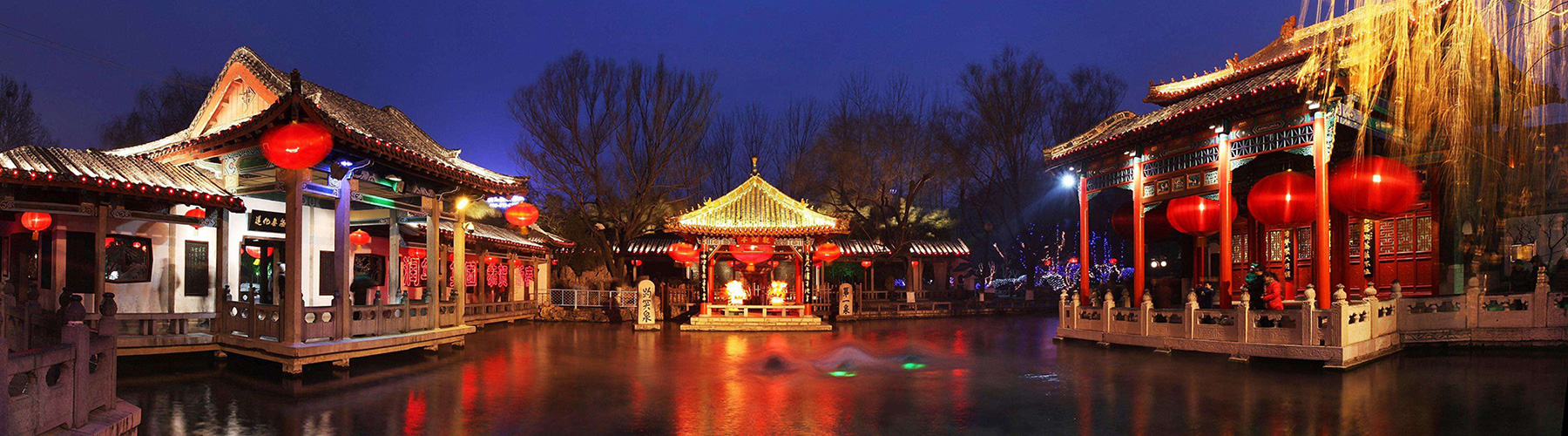
Setting Sun over the Waves, the North Water Gate and Huibo Tower

Setting Sun over the Waves is one of the Eight Old Scenes and one of today’s Sixteen New Scenes of Daming Lake. On the top of Huibo Tower, people can see the Thousand Buddha Hill on the south, while Que Hill and Hua Hill on the north. Under the tower, the water of the lake is shining below the sunset. In the past, the fishermen were singing merrily to go home for dinner after a day’s work. The harmonious and tranquil scene made visitors reluctant to leave. Hence people in the old time named this scene as “Setting Sun over the Waves”. The Chinese words were written by Liu Haisu, a great painter in China.The North Water Gate under Huibo Bridge is also called Huibo Gate. It was built by Zeng Gong when he was the governor of Jinan. In 1072, in order to manage the floods in the north area of Jinan, Zeng Gong took his men to build the North Water Gate. He composed an article named The Record of Constructing the North Water Gate. The article was written by a calligrapher named Chen Gengqiao and carved on the stele by the North Water Gate.Besides working as the water gate to control the water level of Daming Lake, the North Water Gate is also the north gate of the city of Jinan. With a history of one thousand years, it is well-preserved and still protects the old town from floods. It can be listed into the masterpieces of the ancient drainage works. Because of its sufficient water source from the springs nearby and convenient drainage, Daming Lake keeps its constant water level, unaffected by heavy rains or severe drought.Huibo Tower is located above the North Water Gate. It was first built at the beginning of the Yuan Dynasty and was rebuilt in the Yuan and Ming Dynasties. Today’s Huibo Tower was built in 1982. It is a two-storied traditional Chinese gate-tower. It is not only a good place to watch the views of the lake but also the location of Huibo Chess Club. The three Chinese words were written by Li Xiongcai, a modern calligrapher and painter.Located on the northeast bank of Daming Lake, Nanfeng Shrine (Zeng Gong Memorial) also named Zeng Gong Shrine, was built in memory of Zeng Gong, one of the Eight Great Masters of Tang and Song Dynasties. Zeng Gong was born in Nanfeng County of Jiangxi Province, so he was called “Sir Nanfeng” by scholars at that time. He was appointed as Chief Magistrate in Qizhou (today’s Jinan). He advocated innovations on the town’s laws and the local education, reduced the taxes, built north water gate, improved the drainage system and built pavilions and bridges on Daming Lake. Floods were effectively controlled and Daming Lake came into being from then on. He was so successful as a magistrate in Jinan that “local people blocked bridges, roads and gates to prevent Zeng Gong from leaving for next official position, and he had to leave late at night”. Therefore, the Memorial was built to commemorate him.
It is not clear when Nanfeng Shrine was first built. It was rebuilt in 1829 in the reign of Emperor Daoguang of the Qing Dynasty. In 1994, it was rebuilt. There are three rooms in the Hall with Zeng Gong’s statue in the middle. Made of camphorwood from Zeng Gong’s hometown, the statue is two meters tall. With a book in the hand, the statue presents a learned and refined gentleman to the visitors. The couplets on the pillars are “As a great poet in the Northern Song Dynasty; Zeng Gong was honorably called Sir Nanfeng”.
Across the Shrine is the old Opera House of Jinan, Nanfeng Stage. Jinan Folk Arts Troupe performs here everyday. Visitors from all over the world can enjoy the traditional and authentic folk arts of Jinan. There are five rooms on the east part of the Hall. Mr. Sun Mofo and his son’s calligraphies and paintings are on exhibition there.
Yangong Terrace is in the east of the yard. Mingchang Bell Pavilion is on the terrace. Cast in the Jin Dynasty, Mingchang Bell is hanging inside the pavilion. Mingchang literally means Daming Lake will prosper for ever. The bell weighs eight tons with the Eight Diagrams on the surface and a dragon-shaped handle on the top. The couplets were written by Mr. XuBeiwen. The lines read “When the bell rings, the frogs are quiet; while the moon rises, the visitors’ dreams are awoken.”
There is a waterside pavilion named “Rain & Lotus Hall” by the lake in the yard. With red pillars, green tiles, upturned eaves, tracery windows and gates and corridors around it, the pavilion faces the lake and is a good place to listen to falling rain and watch the lotuses.
The Temple of Goddess of Lotus Root is also called “The Temple of the Goddess of Water”. There has been a custom to offer sacrifices to the Goddess of Lotus Root in Daming Lake. The original place is near Tie Xuan Memorial. It was recorded in The Travels of Laocan written by Liu E in the Qing Dynasty. The temple was rebuilt here in 1998. Based on the historical record from the Qing Dynasty, Li Qingzhao was regarded as the Goddess of Lotus Root. Her statue was worshipped inside it. The murals on the wall are the legends and pictures of Daming Lake.
Beiji Palace is also called Beiji Temple and is one of the relics in Daming Lake. It is located on the north bank of Daming Lake. Originally built in 1280, it is the biggest Taoist Temple existing in Jinan. The whole temple consists of a bell tower, a drum tower, front and rear palaces, and wing rooms.
In the front hall, the golden statue of Zhenwu God is in the middle of the niche, with Golden Boy and Jade Girl standing on both sides. Under the niche are Fire General, Water General, Turtle General and Snake General. On the two sides of the niche are six Gods in charge of different missions. On the east and west walls are the murals depicting the legends of Zhenwu God. Zhenwu was originally the prince of Jingle Kingdom in the west. Unlike other men, he was born with tremendous bravery and uninterested in the throne. He was fascinated by Taoism and gave up his throne to continue his religious training in Wudang Mountain in China. After 42 years’ hardship and training, he finally became Zhenwu God. The rear hall is Qisheng Palace which was built in 1465. Zhenwu God’s parents’ statues are enshrined in it.
Beiji Temple is a high place on the north bank of Daming Lake. Standing on Beiji Temple, one can have a wide view of Daming Lake.
The Spring of Response Well is located to the east of Beiji Temple. The spring was found out when Beiji Temple renovated in the Ming Dynasty. In 1514, a stele named The Record of the Spring of Response Well was erected by the spring. The article was written by Bian Gong, a well-known scholar at that time